The Northern Green Mountains
Bioregional Perspectives
Facing a less globalized future — one of more local and regional exchange — we explore new terriorial entities.
In order to anchor our approaches in the natural reality of our territory, we look beyond administrative boundaries.
The Green Mountains are an Appalachian mountain range stretching 400 km, most of which lies in the United States, in the state of Vermont — the Green Mountain State. The Northern Green Mountains, as defined by Corridor Appalachien, are "the Quebec portion of the Green Mountains." We appreciate the addition of "Northern" in the name: it adds geographic precision and carries a bit of nordic identity.
Corridor Appalachien, a conservation and environmental protection organization in southern Quebec, articulates a bioregional vision we share — one that highlights the ecological and biological value of this region.
We operate in the Northern Green Mountains, a key ecological link between the Northern Appalachians and Acadia regions. The Northern Greens are home to one of the most intact stretches of continuous temperate hardwood forest in the world. Since nature knows no borders, our work embraces a cross-border vision, in harmony with conservation efforts taking place beyond the Canada–US border.
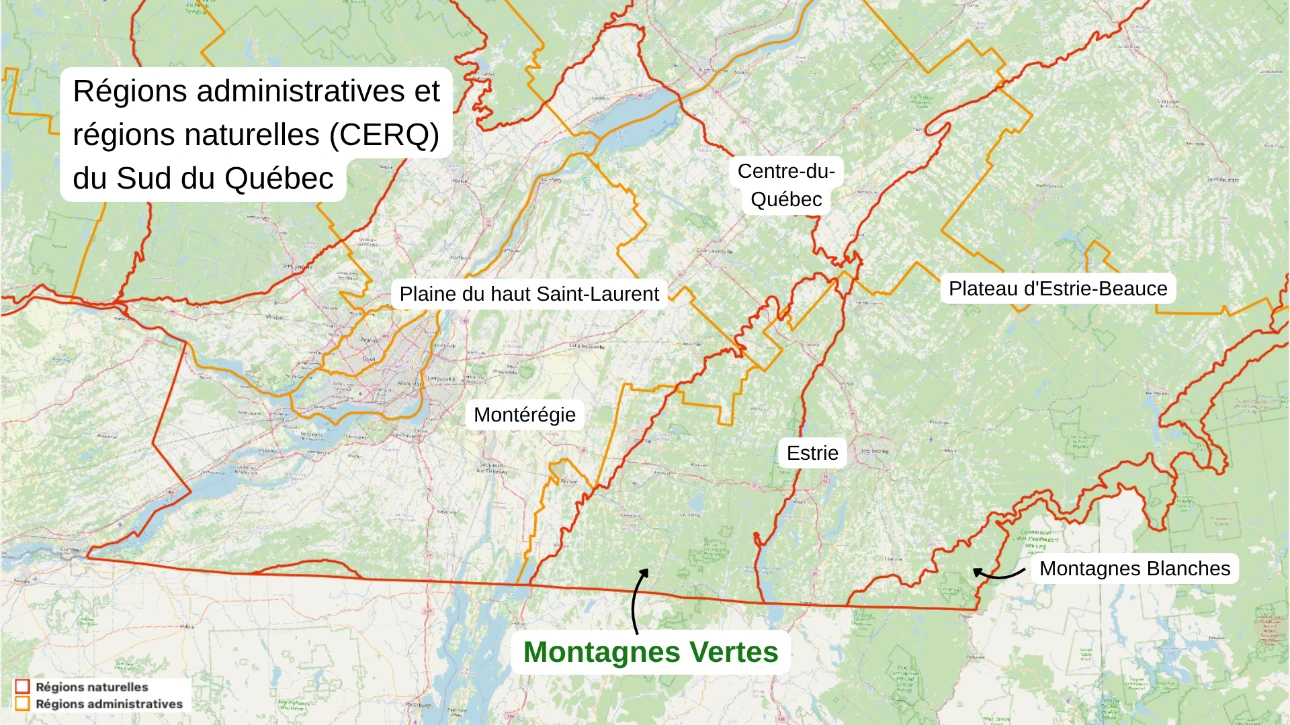
Within Quebec's Ecological Reference Framework (CERQ), the Green Mountains also is a designated natural region. The CERQ offers a useful starting point for thinking about territorial boundaries at multiple scales. Its four highest hierarchical levels are: natural provinces > natural regions > physiographic units > ecological districts.
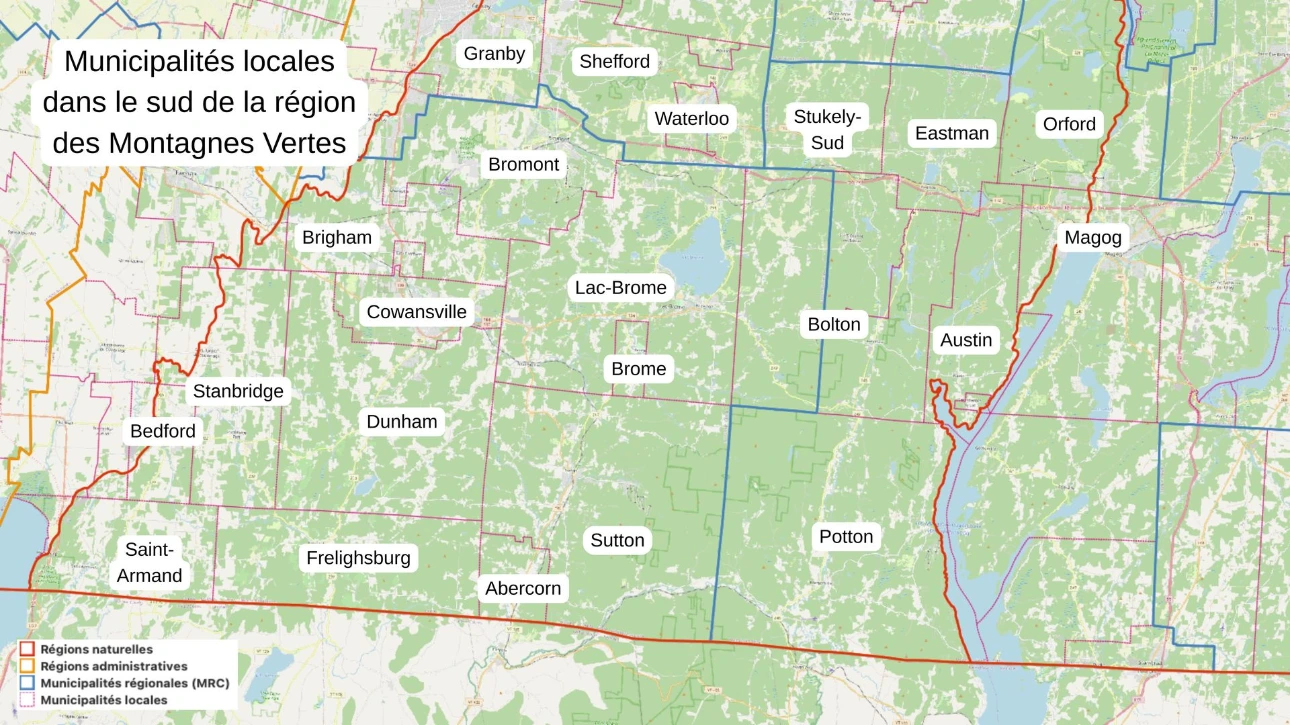
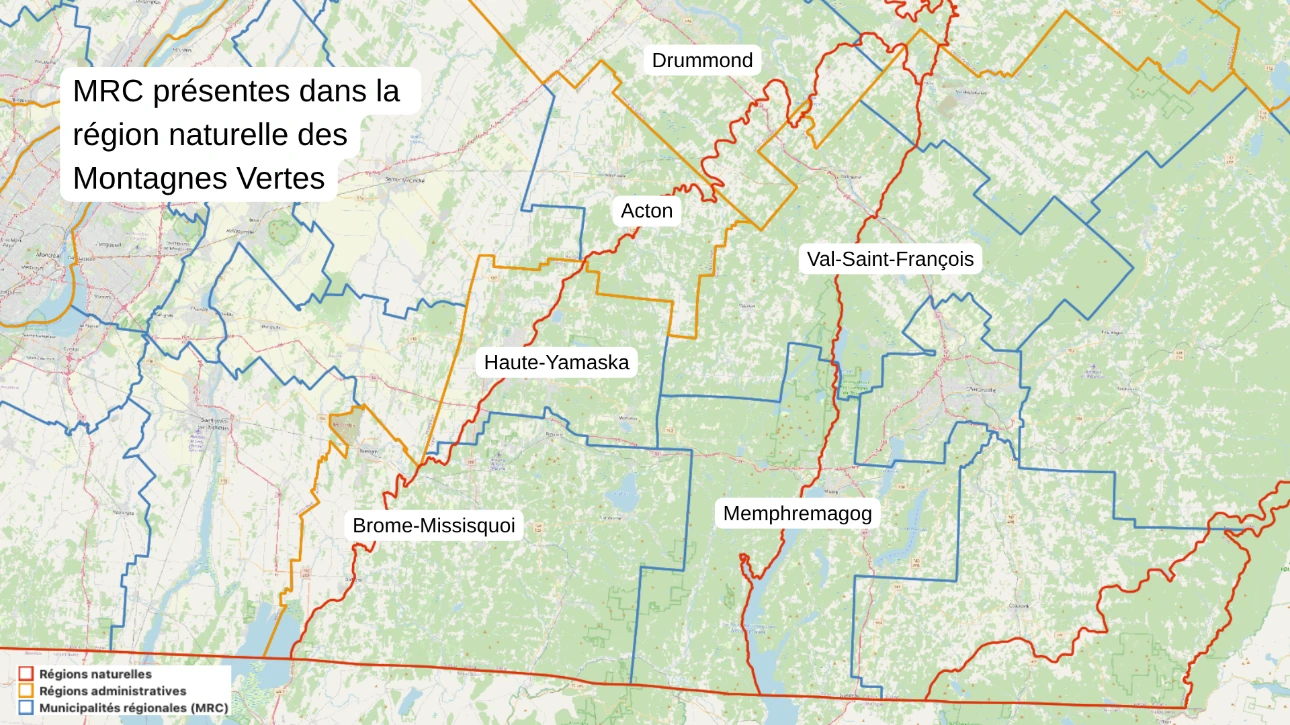
However, at 3,777 square kilometres, the Green Mountains natural region is too large for our scale of action. We have therefore chosen to focus on its southern portion, where we live. The two primary regional county municipalities (MRCs) found in this area are Brome-Missisquoi and Memphremagog. The current limits of our area of action are Highway 10 to the north, the US border to the south, Lake Memphremagog to the east, and the Appalachian piedmont / foothills to the west.
These boundaries are not meant as rigid limits, but as a starting point for inclusive reflection — one that stimulates collective intelligence and helps bring the philosophy of bioregionalism home.
Last but not least, way before the words of European languages were added and superimposed upon this land a few hundread years ago, the Abenaki people lived in deep relationship with this territory. Ndakina — "Our Land" — is the name for the ancestral territory of the W8banaki Nation.
The Ndakina Office
TO RALLY AND MOBILISE FOR THE PERPETUAL SAFEGUARD OF THE NDAKINA

Focus on the natural region of the Green Mountains
Location of the natural region in Southern Quebec
Regional municipalities overlapping the natural region
Local municipalities in the southern portion of the natural region